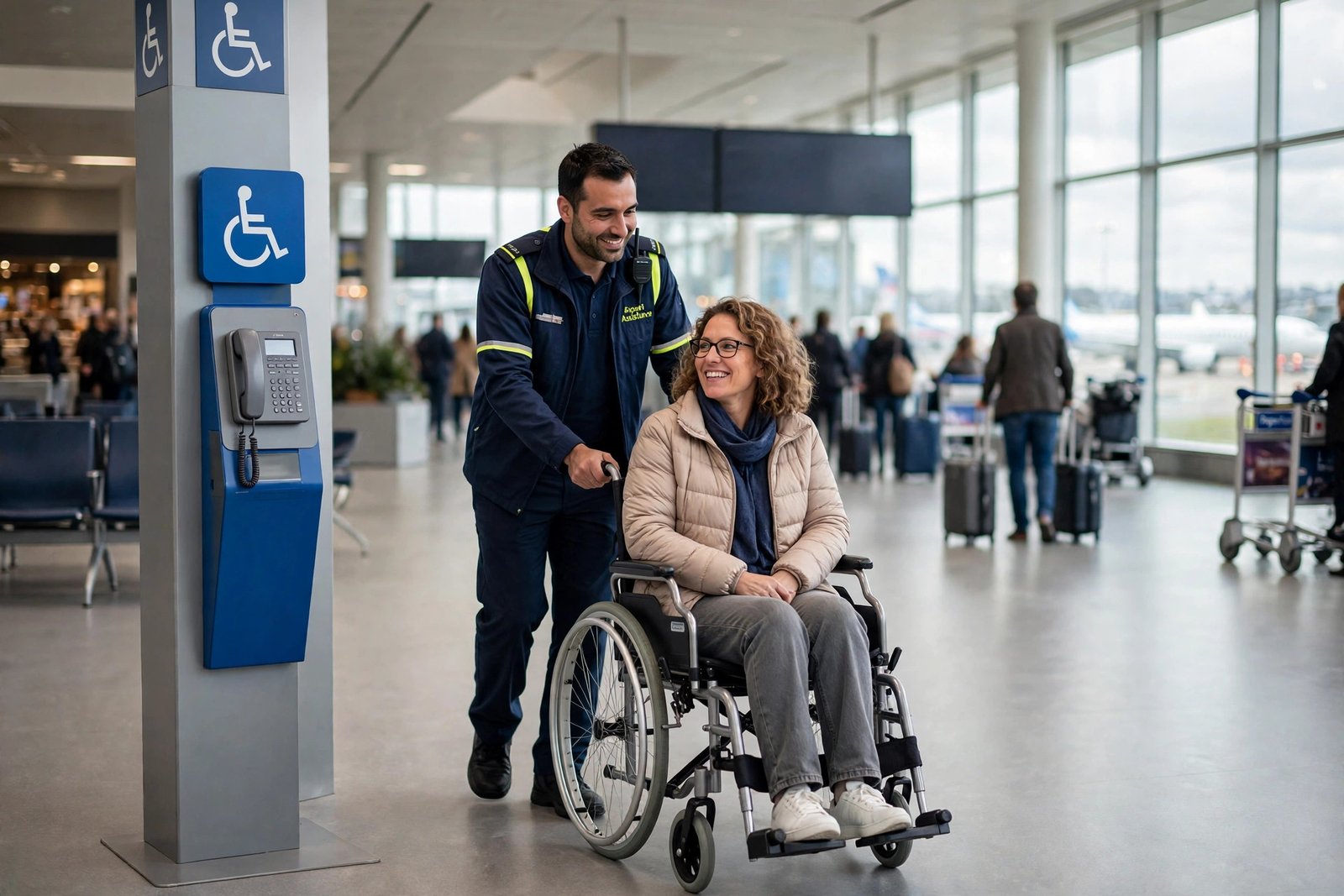
UK airport assistance, also called special assistance, is free help for any passenger who needs extra support getting through the airport and onto the plane. It runs from the moment you arrive at the airport until you are in your seat, and it picks up again when you land. You ask for it through your airline, not the airport, and you should ask when you book or at least 48 hours before you fly.
Demand for the service is high and growing. The Civil Aviation Authority reported that 5.9 million passengers used assistance services at UK airports in 2025, up from 5.5 million requests in 2024. This guide explains who can use it, how to book it, what help you actually get at each stage of the journey, and what to do if it goes wrong. For the flight itself, including wheelchairs, batteries and damage rights, see our practical guide to flying with a wheelchair.
Who Can Use Special Assistance?
Anyone who has difficulty moving through an airport because of a disability, age, injury or illness can use special assistance. That includes wheelchair users, people who can walk short distances but not the length of a terminal, older travellers, people with a temporary injury such as a broken leg, and people with hidden disabilities such as autism, dementia, anxiety, hearing loss or a visual impairment.
You do not have to be a wheelchair user, and you do not have to be travelling alone to qualify. Parents travelling with a disabled child, carers travelling with the person they support, and people travelling with an assistance dog can all ask for help. The service also covers connecting flights, so if you change planes, assistance should be arranged at each airport on your route. If you are planning the trip itself, our guide to the best UK destinations for wheelchair users covers places where the help continues once you land.
Your Legal Right to Free Assistance
Your right to assistance comes from Regulation 1107/2006, which the UK kept in law after Brexit. It gives you free assistance when you fly from a UK airport on any airline, or to a UK airport on a UK or EU airline. The Civil Aviation Authority, the CAA, is the regulator that enforces it, and its guidance sets out exactly what airports and airlines must provide.
An airline cannot refuse your booking or boarding because of your disability or reduced mobility if you hold a valid ticket and reservation. The only exceptions are narrow ones: safety requirements set by law, or a case where the aircraft or its doors make boarding physically impossible. Even then, the airline must try to offer an acceptable alternative, and if you ask, it must give its reasons in writing within five working days. If your wheelchair or other mobility equipment is lost or damaged, it must be compensated. Our guide to travel insurance for wheelchair users explains how insurance and the airline’s liability fit together.
How to Book Special Assistance: The 48-Hour Rule
Ask for assistance when you book your tickets, or at least 48 hours before departure, through your airline, travel agent or tour operator. Airlines, travel agents and tour operators must offer a free way to request assistance when you book or at a later stage, but it is not always automatic, so you may need to ask. Look for an assistance link when you book online, or call the airline. Many airlines provide Freephone or local rate numbers, and some offer a free call back service. The CAA’s own guide to how to access help and support walks through the same steps.
Requesting early matters because it gives the airport and its assistance provider time to prepare. If you do not give advance notice, you may face delays or not receive the support you need. Always request and keep written confirmation of your assistance reservation, and keep it with your booking details. Be specific when you book: say whether you use your own wheelchair or need an airport one, whether it is manual or powered, whether you can walk short distances or manage steps, and whether you need help with anything else, such as oxygen, medication or an assistance dog. At the same time, buy travel insurance and check that it covers your equipment and your medical needs. Our comparison of accessible travel insurance versus standard travel insurance explains the differences that matter most.
The Three Wheelchair Codes: WCHR, WCHS and WCHC
Airlines use three standard codes to record how much help you need, and knowing yours makes booking quicker and avoids the wrong level of help turning up. The code travels with your booking, so every station on your route sees the same information. Ask the airline which code it has put on your booking, and check that it matches what you actually need.
| Code | What it means | Who it usually fits |
|---|---|---|
| WCHR | You can walk short distances and manage stairs, but you need a wheelchair for long distances in the terminal | Fatigue, breathlessness or pain on long walks |
| WCHS | You can walk short distances but cannot manage stairs, so you need a wheelchair to the aircraft door and a lift or air bridge instead of steps | Severe joint problems or recent leg or hip surgery |
| WCHC | You cannot walk at all and need a wheelchair all the way to your aircraft seat, usually with an aisle chair for the last part | Full time wheelchair users and people with very limited mobility |
The code is a starting point, not the whole answer. If you can walk on a good day but not on a bad one, say so, and book the higher level of help. Your own wheelchair or mobility aid travels in the aircraft hold free of charge and does not count against your baggage allowance.
At the Airport: From the Assistance Point to the Gate
On arrival, head to an assistance point. These are typically inside or outside the terminal, at drop off points, car parks, train stations and bus terminals, and there should be signs showing where the special assistance help desk is. Assistance points usually carry a disability related logo and include a buzzer or telephone so you can call for help if the point is not staffed when you arrive. If you park in a medium or long term car park, you may need to use the airport bus service to reach the terminal, and in the UK that service is generally accessible.
Assistance staff can take you to a waiting area, help you through check in and bag drop, take you through security into the departure lounge, and get you to the gate. Alternatively, a companion can escort you through the airport, including pushing you in a wheelchair. If you use your own mobility aid, you should be able to use it up to the departure gate before it is stored in the aircraft hold. Airlines recommend allowing extra time for check in if you require assistance, so arrive earlier than you would for an ordinary flight. What goes in your carry on matters too, because your chair goes in the hold, so check our comparison of hand luggage size rules for UK airlines before you pack.
Security, Boarding and the Flight Itself
At security, assistance staff stay with you and can explain what will happen before any search takes place. People with hidden disabilities must never be separated from a parent, friend or accompanying person during a security search, and staff should explain the screening and make reasonable adjustments. If you wear a lanyard or badge, it signals to staff that you may need extra patience or support, and it is entirely optional.
At the gate, travel assistance staff can help you move through the gate, board the aircraft using lifts, ramps or transfer wheelchairs, reach your seat and stow your carry on bags if required. Before you travel, ask the airline the questions the CAA suggests: does it provide onboard wheelchairs for toilet access, how far is the walk to the gates, does the airport use air bridges or steps, are there accessible toilets on the aircraft, and what are the rules on oxygen, medication and mobility aids.
During the flight, the airline should provide assistance in moving to the toilet if needed, and most airlines have onboard wheelchairs available. If necessary, ask to be seated near the toilet. There are limits worth knowing in advance. Airline staff are not expected to help with eating, drinking or taking medication, or with using the toilet. If you need that support, you may need to travel with a person who can provide it. Airlines must also provide flight safety details in an accessible format, so if you need a personal safety briefing, tell the airline before you travel.
At Your Destination Airport
Your wheelchair or mobility aid should be returned to you at the arrival gate unless there are extenuating reasons, so you are not left waiting at baggage reclaim for the chair you need. You may also be eligible for assistance through immigration, customs and baggage claim, and to exit points, which can include some car parks, train stations and drop off points.
If you have a connecting flight, assistance should be arranged for the transfer as well, but confirm this when you book rather than assuming it. Once you are through the airport, the same planning applies to where you stay. Read our guide on how to book an accessible hotel room, and check the wording hotels use, because what wheelchair accessible actually means varies a lot from one hotel to the next.
Hidden Disabilities: Lanyards, Quiet Areas and Extra Time
Special assistance is not only for visible disabilities. The CAA updated its guidance for passengers with hidden disabilities in October 2026, setting out how UK airports should support people with conditions including dementia, autism, mental health problems, hearing loss and visual impairment. Airports should provide clear, detailed information to help you familiarise yourself with the airport before you travel, including accessible videos, photos and pictures of airport processes.
You can ask for a sunflower lanyard, bracelet or badge so staff can see you may need help, and many airports offer quiet areas to wait and quiet routes through the terminal that bypass the retail area, which helps in particular if you have a sensory impairment. Airport staff, including security staff, should have hidden disability awareness training. None of this needs a diagnosis to be shown at the airport. Asking for what you need, in plain words, is enough.
When Things Go Wrong: Complaints and Compensation
If help fails, tell staff straight away, while you are still at the airport, because that gives them a chance to fix it on the spot. Keep a note of times, names, flight numbers and what was promised, and keep your written assistance confirmation. Then use the airline or airport complaints procedure. If that does not resolve it, you can escalate to an approved alternative dispute resolution scheme or to the CAA’s Passenger Advice and Complaints Team. Consumer Protection UK’s guide to airport assistance for disabled passengers summarises the same escalation route and the law behind it. The law is clear on one point: lost or damaged wheelchairs and other mobility equipment must be compensated, so photograph your equipment before you travel and report damage before you leave the airport. If assistance failure also delays your flight, our guide to flight delay compensation in the UK explains what you may be owed under UK261.
Frequently Asked Questions
Is UK airport assistance really free?
Yes. Assistance is free of charge when you fly from a UK airport on any airline, or to a UK airport on a UK or EU airline. The cost is covered by the airport and airline, not by you, and nobody should ask you to pay for it.
Do I need to prove my disability to get assistance?
No. In the UK you do not usually need to prove that you have a disability or that you need special assistance. You only need to describe what help you need. A lanyard or badge is optional and is there to help staff recognise that you may need support.
What happens if I turn up without booking assistance?
You can still ask for help at an assistance point on the day, and staff will do what they can. Without advance notice, though, you may face delays or not receive the support you need, especially at busy times. Booking at least 48 hours ahead is the only way to be sure the right help is waiting.
Can I take my own wheelchair to the gate?
Yes. You can normally use your own wheelchair or mobility aid right up to the departure gate, where it is taken to be stored in the aircraft hold. It should be returned to you at the arrival gate when you land, and it travels free of charge outside your baggage allowance.
Can my companion stay with me through security?
Yes. A companion can escort you through the airport, including pushing your wheelchair, and people with hidden disabilities must never be separated from their companion during a security search. Tell the airline when you book if you are travelling with a carer or companion who needs to stay with you.