You tick the wheelchair accessible filter, you book the room, you arrive, and the bathroom door is too narrow for your chair. Or the room is step-free but the bed is a fixed platform your hoist cannot slide under. It happens to wheelchair users again and again, because the label on the booking page is a claim, not a certificate. This guide explains what “wheelchair accessible” actually means in a UK hotel, the numbers behind the label, the rating scheme that does exist, and how to check a hotel before you book. If you want the practical booking steps that go with this guide, our guide to booking an accessible hotel room lists the questions to ask before you pay.
The Short Answer: “Wheelchair Accessible” Is a Claim, Not a Certificate
There is no single legal definition of a wheelchair accessible hotel room in the UK, and no law that says what a hotel must do before it can use those words. Every hotel, chain and booking site uses the label a little differently. One hotel may call a room accessible because it has a grab rail and a wide door, while another uses the same label for a room with a roll-in shower, a low bed and space to turn a powerchair. The label is a starting point for your search, not a guarantee that the room will work for you.
That does not make the label useless. It narrows a long list of hotels down to the ones that have thought about access at all. The mistake is to stop there. Treat the label as a promise to check, not a fact to trust, and the chances of an unpleasant surprise on arrival fall sharply.
What the Law Actually Requires Hotels to Do
The Equality Act 2010 is the law that matters most here. It says that service providers, including hotels, must not discriminate against disabled people and must make reasonable adjustments so that disabled guests can use their services. You can read the official overview in the GOV.UK Equality Act 2010 guidance. Reasonable adjustments can mean changing a physical feature, such as adding a ramp or widening a door, or providing an aid, such as a shower chair or a vibrating fire alarm.
What the Act does not do is define “wheelchair accessible” or set out a checklist a room must pass before a hotel can use the words. New hotels are shaped by the Building Regulations, which set access standards for new buildings, and by British Standard BS 8300, which gives detailed guidance on designing accessible buildings. Those documents influence how new hotels are built, but they do not certify the label on a booking site, and older hotels were often built long before the current standards existed.
In practice, this means the law protects you if a hotel refuses you a service or fails to make a reasonable adjustment, but it does not stop a hotel from describing a partly adapted room as accessible. If a room you booked as accessible turns out to be unusable, keep the booking confirmation and take photos, because evidence matters if you complain later.
The Numbers Behind the Label: Doors, Turning Space and Beds
When a hotel does give you measurements, a few figures matter more than all the marketing words put together. VisitEngland’s key accessibility features questionnaire, which hotels use to describe their rooms in detail, sets a minimum door width of 750mm for a wheelchair accessible bedroom, rising to 800mm in Scotland, and many access advisers use 800mm as the working guide for a comfortable fit. The same questionnaire asks for a wheelchair turning space of at least 1,500mm by 1,500mm in the bedroom and the bathroom, and an emergency assistance alarm in the room.
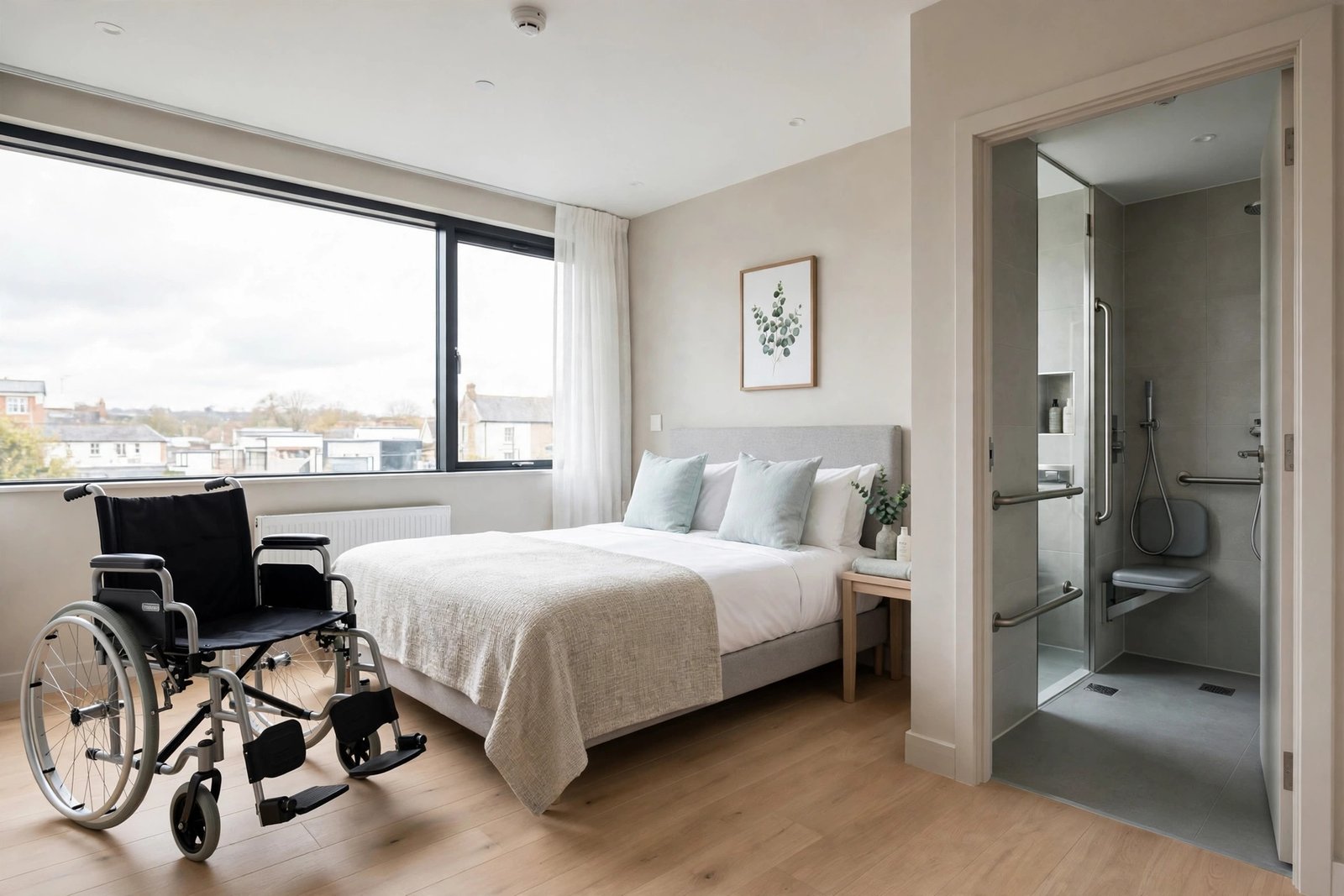
The bed matters as much as the door. You need clear space beside the bed to transfer, a bed height that matches your transfer, and clear space under the bed if you use a mobile hoist. A fashionable fixed platform bed can pass every door measurement in the building and still make the room unusable, because a hoist cannot slide underneath it. In the bathroom, the questions are whether the shower is a genuine roll-in shower or a shower over a bath, whether there is space to transfer onto the toilet, where the grab rails are, and whether you can reach the sink in your chair.
| Feature | What to ask for | Why it matters |
|---|---|---|
| Bedroom door | Clear width in millimetres, at least 750mm, ideally 800mm | Your chair has to fit through it, with room to spare |
| Turning space | At least 1,500mm by 1,500mm clear floor in bedroom and bathroom | You need to turn and position your chair without moving furniture |
| Bed | Height, space beside it, and clearance underneath for a hoist | A bed you cannot transfer onto makes the whole room unusable |
| Bathroom | Roll-in shower or bath with seat, grab rails, transfer space by the toilet | This is where most “accessible” rooms fail in practice |
| Emergency alarm | Alarm cord or button you can reach from the bed and the bathroom floor | Safety matters most when you are alone in the room |
The National Accessible Scheme: M1, M2, M3 and the V and H Ratings
The closest thing the UK has to a standard rating is the National Accessible Scheme, run by VisitEngland. Hotels and other accommodation that join the scheme are assessed against set criteria and can display a rating logo for mobility, visual or hearing impairment. The full standards are published in the National Accessible Scheme standards document, and the ratings work like this.
| Rating | Who it is for | What it means |
|---|---|---|
| M1 | Older and less mobile guests | Stairs can be managed with banisters or grip handles, and some help is available |
| M2 | Part-time wheelchair users | Guests who can walk a few steps at most, or use a wheelchair some of the time |
| M3I | Independent wheelchair users | Full wheelchair access for guests who travel independently |
| M3A | Assisted wheelchair users | Full wheelchair access for guests who travel with someone who helps them |
| V1 and V2 | Visually impaired guests | Minimum entry level (V1) and best practice level (V2) for sight loss |
| H1 and H2 | Hearing impaired guests | Minimum entry level (H1) and best practice level (H2) for hearing loss |
| Access Exceptional | Wheelchair users who need the highest standard | Meets M3I or M3A requirements plus more demanding criteria from BS 8300 |
Two things are worth knowing about the scheme. First, it is voluntary, so most hotels are not in it, and the absence of a logo does not mean a hotel is inaccessible. Second, a logo is far more useful than a bare “accessible” label, because it tells you the hotel has been assessed against published criteria for your specific needs. When you see M3I, you know the hotel has been checked for independent wheelchair use. Our best UK destinations for wheelchair users and our wheelchair accessible holidays guide for the UK list places where assessed and well described accommodation is easier to find.
“Accessible”, “Disabled-Friendly” and “Step-Free”: What Each Label Promises
Hotels and booking sites use a handful of labels that sound similar but promise very different things. Knowing the difference saves you from booking a room that is accessible in one sense and unusable in yours.
| Label | What it usually means | What it does not guarantee |
|---|---|---|
| Wheelchair accessible | Step-free access and at least one adapted room | Which features are adapted, or whether they suit your chair |
| Accessible room | A room with some adaptations, such as grab rails or a wider door | A roll-in shower, a suitable bed, or turning space |
| Disabled-friendly | A welcoming attitude and some awareness of access needs | Almost nothing physical, as it is usually a marketing phrase |
| Step-free access | No steps on the route described, usually into the building | Wide doors, a lift, or step-free access to the restaurant and bar |
| Accessible bathroom | The bathroom has some adaptation | Whether that means grab rails only or a full wet room |
“Disabled-friendly” is the weakest of the set. It usually describes an attitude rather than a room, and access advisers recommend ignoring it on its own and looking for the actual features instead, such as door widths, step-free routes and bathroom layouts. “Step-free” is more useful, but only for the route it describes. A hotel can be step-free at the entrance and still keep its restaurant down a flight of stairs, so always ask whether the step-free route reaches the room, the restaurant, the bar and the breakfast room.
Five Things the Label Never Tells You
Even a room that genuinely deserves the label can still catch you out, because the label says nothing about the details that decide whether a stay works. These five are the ones wheelchair users report most often.
1. The bed. A fixed platform bed with no clearance underneath blocks a mobile hoist completely, and a very high or very low bed can make transfer hard or impossible. Ask for the bed height and whether there is space under it before you book, not after you arrive.
2. The bathroom layout. Two rooms can both be sold as having an accessible bathroom when one has a roll-in shower with a fold-down seat and the other has a shower over a bath with a single grab rail. Ask which one it is, and ask for the transfer space beside the toilet.
3. The rest of the hotel. Your room may be fully accessible while the restaurant, bar, pool or breakfast room is not. Ask whether every place you will use during the stay is on the step-free route, and whether the lift serves all floors.
4. The lift. A lift that is too small for a powerchair, or one that is out of order with no alternative, can strand you on the ground floor. Ask for the lift’s internal size and whether there is a second lift or a ground-floor room as a backup.
5. Parking and arrival. An accessible bay a long walk from the entrance, a steep slope from the car park, or a drop-off point with no level route to reception can spoil an otherwise good stay. Ask how far the accessible parking is from the entrance and whether staff can help with luggage at the door. If you travel with someone who helps you day to day, our guide to holidays for disabled people and carers covers companion arrangements worth asking about at the same time.
How to Check a Hotel Before You Book
The most useful document a hotel can give you is its access statement or accessibility guide, a detailed description of the building with real measurements for door widths, bed and desk heights, turning space and bathroom layout. Good hotels publish one on their website, and the best ones keep it up to date. If a hotel has a detailed access guide from AccessAble, that is even better, because AccessAble surveys the property in person and records measurements rather than relying on the hotel’s own description.
Read the access statement first, then look at photos of the actual accessible room, not the standard room, and then phone the hotel. Ask your three most important measurements on the call, and ask the person to check the room rather than guess. If the answers matter to your stay, ask for them in an email so you have them in writing with your booking. Booking site filters are a useful starting point, but every site defines “wheelchair accessible” differently, so always cross-check on the hotel’s own website before you pay. If your trip also involves a flight, our practical guide to flying with a wheelchair covers assistance, batteries and your rights if your chair is damaged.
What to Do When the Room Does Not Match the Label
Tell reception straight away, while there is still time to fix it. Ask for a different accessible room, a move to a room that works, or help to make the room usable, such as a shower chair or the removal of furniture that blocks your turning space. Stay calm and specific about what does not work, and note the name of the person you speak to.
If the hotel cannot fix it, ask for the duty manager and ask what they will do instead, whether that is a room in a nearby hotel at their cost, a partial refund, or a full refund so you can leave. Keep your booking confirmation showing the accessible room you booked, take photos of the problem, and keep receipts for anything the failure costs you. Afterwards, complain in writing to the hotel and, if you booked through a platform, to the platform as well. If the stay was part of a longer trip abroad, our guide to planning disabled holidays abroad covers the extra checks that stop the same problem happening overseas. This guide is general information, not legal advice, and if you believe a hotel has broken the Equality Act, a disability advice service or a solicitor can tell you where you stand.
Frequently Asked Questions
Does “wheelchair accessible” mean the whole hotel is step-free?
No. It usually means the entrance and at least one bedroom are step-free, but the restaurant, bar, pool or breakfast room may still be reached only by stairs. Ask whether the step-free route covers every part of the hotel you plan to use.
What door width do I need for a wheelchair?
It depends on your chair. Guidance used by VisitEngland sets a minimum clear door width of 750mm for a wheelchair accessible bedroom, and many advisers use 800mm as the working guide. Measure your chair at its widest point, add room for your hands, and compare that figure with the hotel’s measurement rather than trusting the label.
Is a hotel breaking the law if its accessible room is not usable?
It depends on the facts. The Equality Act 2010 requires hotels to make reasonable adjustments for disabled guests, and advertising a room as accessible when it cannot be used may be a failure to do that. Keep evidence, complain to the hotel in writing first, and get advice before taking it further. Before you travel, it is also worth checking that your travel insurance covers your wheelchair and mobility equipment, so a damaged chair does not end the trip.
What is the difference between M3I and M3A in the National Accessible Scheme?
M3I is for independent wheelchair users who travel without everyday help, while M3A is for assisted wheelchair users who travel with a friend, family member or carer who helps them. Both mean the accommodation has been assessed for full wheelchair access, and the difference is about how much help you need rather than how good the access is.
Should I trust the accessible filter on a booking site?
Use it to build a shortlist, then verify. Booking sites apply the filter from the information hotels give them, and hotels describe their own rooms, so the same filter can mean very different rooms on different sites. Check the hotel’s own access statement and phone the hotel before you pay, especially if you need a hoist, a roll-in shower or a specific bed height. For a broader look at planning a trip around access, our guide to holidays for people with disabilities in the UK brings the transport, accommodation and insurance pieces together.