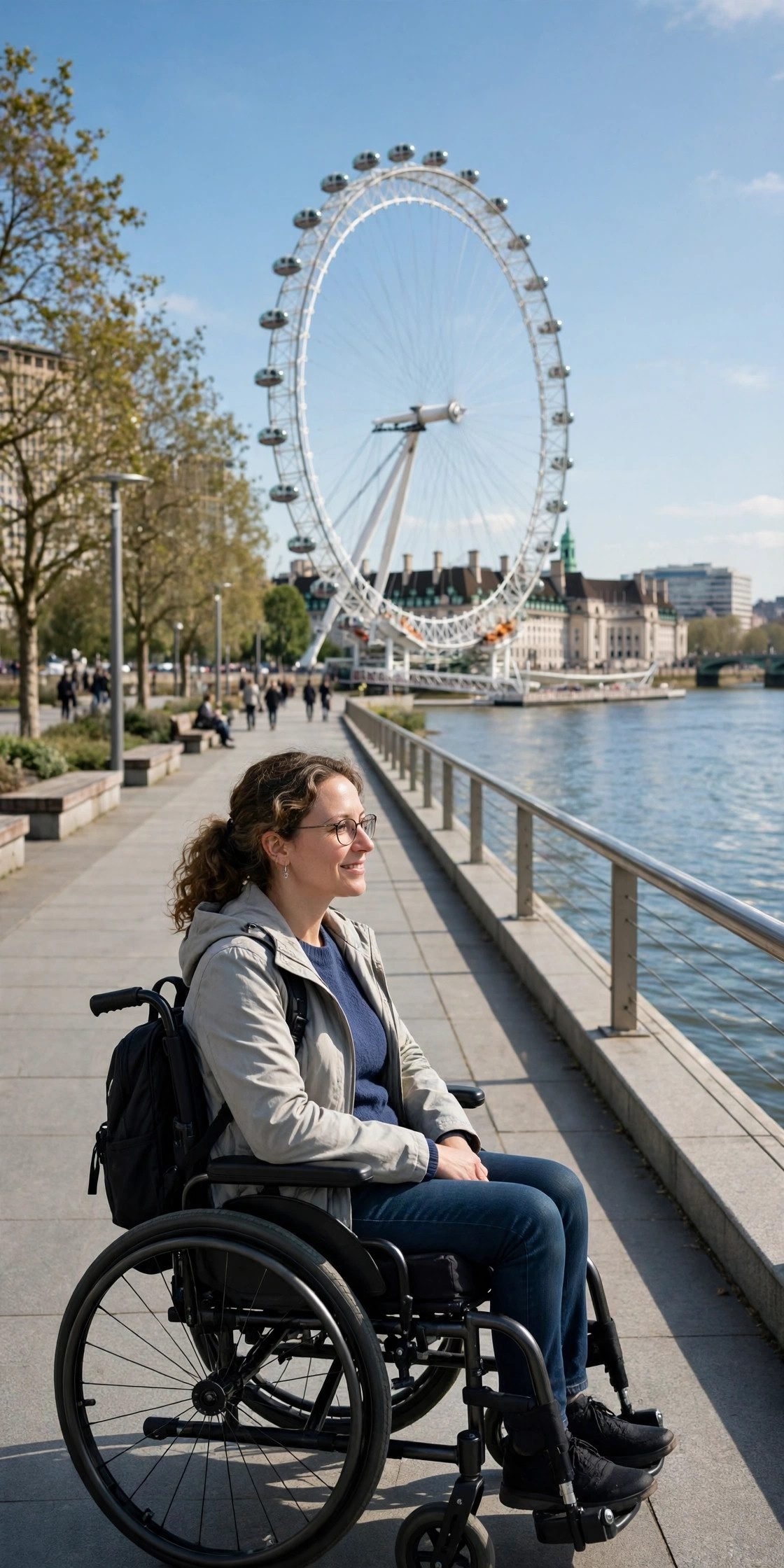
London has a reputation for being hard work in a wheelchair, and some of that reputation is fair. The Tube is more than 160 years old, and plenty of its stations still have stairs and no lift. But a step-free trip is now very doable if you plan around the parts of the network that work well, and this itinerary shows how.
It covers three days in central London, all of it step-free from street to sight, using the Elizabeth line and buses for most journeys. It is honest about the places where a wheelchair still meets cobbles or stairs. If you are planning a wider trip, our guide to the best UK destinations for wheelchair users puts London in context with the rest of the country.
What Step-Free Actually Means in London
Step-free means you can get from the street to the platform without using stairs or escalators, usually by lift or ramp. It does not always mean you can board the train on your own. At a station that is step-free to the train, the gap between platform and train is small enough to cross without help, and on the Tube map these stations carry a blue wheelchair symbol. At a station that is step-free to the platform, the lift gets you down, but the step and gap to the train are too large to cross alone, so staff lay a boarding ramp for you. These carry a white wheelchair symbol. The step-free Tube guide prints the size of the step and gap at each station, and it is free to download from Transport for London.
How Much of London Is Step-Free
The honest answer is: a good share of it, and the share keeps growing. Transport for London says 95 Tube stations now have step-free access, more than a third of the network. Northolt became the latest in September 2026, following Colindale in December 2025 and Knightsbridge in April 2025.
The newer parts of the network are the strongest. All 41 Elizabeth line stations are step-free from street to platform, every DLR station is step-free, and every tram stop is step-free. Every London bus is low-floor with a ramp and a wheelchair space, and around 94 per cent of the capital’s 19,000 bus stops are accessible. Transport for London’s step-free access page has the full picture.
Plan Your Route Before You Leave Home
A step-free day starts the night before, with a quick check of each station you plan to use. Lifts go out of service, and a station that is step-free on paper can be useless if its only lift is being repaired. Check again on the morning you travel, and check the return journey too: some stations are step-free in one direction only.
If a lift is out of service, Transport for London will pay for an accessible taxi to a station you can use. Assistance on the Tube, Overground and Elizabeth line is turn up and go, with no booking needed. If you are flying in, read our UK airport assistance guide first, so the journey from the airport is planned the same careful way.
The Elizabeth Line: The Easiest Way Across Town
The Elizabeth line is the backbone of this itinerary. It opened in 2022 and every one of its 41 stations is step-free from street to platform. The trains are long, level and wide, with open space near the doors, and the central section from Paddington to Woolwich has level boarding from platform to train.
For a visitor, the useful stations are Paddington, Bond Street, Tottenham Court Road, Farringdon, Liverpool Street and Canary Wharf. Bond Street puts you on Oxford Street, Tottenham Court Road serves Soho and the British Museum area, and Liverpool Street is the gateway to Spitalfields and the East End.
The Tube: Which Stations Work and Which to Skip
The Tube is the part of the network where you need to be picky. Only around a third of stations are step-free, and the lines vary a lot. The Jubilee line is the strongest of the older lines, with most of its stations step-free, while the Bakerloo line is the weakest, with very few.
Green Park, Westminster, Waterloo, London Bridge, King’s Cross St Pancras and Bank all have step-free routes, though at some of them the step-free route only serves certain lines, so check the line you need rather than the station name alone. Covent Garden, Leicester Square and Piccadilly Circus are all awkward or impossible in a wheelchair, even though they sit in the middle of the theatre and shopping districts. Use Tottenham Court Road or Charing Cross instead and take a bus the last short stretch.
Buses: The Backup That Works Everywhere
London’s buses are the most reliable step-free option in the city, and they are the part of the network most visitors underuse. Every bus is low-floor, every bus has a ramp and a wheelchair space, and the driver can lower the bus to cut the step up from the kerb. Wheelchair and mobility scooter users travel free on buses and trams. Buses also solve the last-mile problem that the Tube creates: a bus stop sits right outside most sights, while the nearest step-free Tube station can be a ten-minute roll away. One limit is that each bus has one wheelchair space, sometimes two, so at busy times you may have to wait for the next bus.
Day One: Westminster and the South Bank Without Steps
Start at Westminster station, which is step-free, and come out by the river. The view across to the London Eye is the classic first sight of London, and the paved riverside path is level all the way. Cross Westminster Bridge and turn left along the South Bank.
The South Bank is one of the best wheelchair routes in the city. The walkway is flat, wide and smooth from Westminster Bridge to Tower Bridge, with the London Eye, the Royal Festival Hall, Tate Modern and Shakespeare’s Globe along the way. The London Eye is fully accessible, but only two wheelchair users are allowed in each capsule, so book a wheelchair time slot in advance. Tate Modern is fully step-free, with lifts to every floor including the viewing level, and entry is free.
Stop for lunch on the South Bank, where the food stalls and riverside restaurants sit on level ground, then keep rolling east towards London Bridge. Black cabs are all wheelchair accessible by law, so a cab is always a workable fallback if your energy runs out.
Day Two: Museums, Markets and the City
Take the Elizabeth line to Tottenham Court Road and walk the short level stretch to the British Museum. The main entrance on Great Russell Street has steps, so use the Montague Place entrance on the north side instead. It is fully step-free, brings you straight into the Great Court by lift, and lifts reach every gallery from there. Entry is free and wheelchairs can be borrowed free of charge.
From the museum, head east to Covent Garden by bus rather than by Tube, since Covent Garden station has no step-free access. The market square itself is level, with street performers and cafes, though the lanes get crowded at weekends. In the afternoon, take the Elizabeth line to Liverpool Street and explore Spitalfields Market, which is level throughout and full of food stalls and small shops.
Day Three: Greenwich and the River
Day three is the DLR day. Every DLR station is step-free, and the ride from Bank or Tower Gateway out to Greenwich is a good tour in itself, running past the towers of Canary Wharf and along the river. Get off at Cutty Sark station and you are in the middle of maritime Greenwich.
The Cutty Sark ship, the National Maritime Museum and the Queen’s House are all close together on level ground, and the museum is free. The Royal Observatory sits on a hill, and the climb is steep, so treat it as optional. For the way back, take the river bus or the DLR rather than the Tube: the river boats that serve Greenwich have step-free boarding at the pier, and the ride back into central London is one of the best views in the city.
Toilets, Rest Stops and Changing Places
Accessible toilets decide how far you can roam, so plan them into each day rather than leaving them to chance. The big museums and galleries all have accessible toilets, and the major stations on the Elizabeth line do too. Tate Modern, the British Museum and the National Maritime Museum are all safe bets.
Changing Places toilets, with a hoist and an adult-sized changing bench, are listed on the official Changing Places map, and it is worth checking which ones sit near your route before you leave the hotel. If you are travelling with a carer, our guide to travelling with a carer covers free companion tickets and discounts across the UK.
Frequently Asked Questions
Is London wheelchair accessible?
Largely, yes, with planning. All buses, all DLR stations, all tram stops and all 41 Elizabeth line stations are step-free, and 95 Tube stations are step-free too. The older Tube stations and some historic sights are the weak points, so plan your routes around the newer lines.
Do I need to book assistance on the Tube?
No. Assistance on the Tube, Overground and Elizabeth line is turn up and go, with no booking needed. Booking ahead is only needed for National Rail services and for some attractions, such as the London Eye wheelchair slots.
Which is the most accessible Tube line?
The Jubilee line has the most step-free stations of the older lines. In practice the Elizabeth line is the easiest option of all, since every station is step-free from street to platform.
Is the Tower of London wheelchair accessible?
Only in part. The Jewel House, where the Crown Jewels are kept, is step-free inside, but reaching it means crossing about 200 metres of uneven cobblestones from the main entrance. Several historic towers are reached only by steep spiral staircases with no lift. The visit is still worthwhile, but go knowing the ground will be rough.
Do wheelchair users pay for London buses?
No. Wheelchair and mobility scooter users travel free on London buses and trams. On the Tube, Overground, DLR and Elizabeth line, standard fares apply, so a contactless card or Oyster card is the simplest way to pay.
The Bottom Line
London is not the easiest city in a wheelchair, but it is far more open than its reputation suggests. Build your days around the Elizabeth line, the DLR and the buses, check each station’s lift status before you set out, and pick your sights with their real access in mind rather than their fame.