A standard accessible toilet works for many wheelchair users. It does not work for everyone. People who need a hoist to transfer, an adult-sized bench to lie on, or room for two carers to help them have long had to cut days out short, stay close to home, or be changed on a toilet floor. Changing Places toilets exist to fix that.
This guide explains what a Changing Places toilet is, what you will find inside one, who they are for, and how to find the nearest before you set off. It also covers RADAR keys, the building rule adding more of them each year, and what to do when the nearest one is locked or broken.
What Is a Changing Places Toilet?
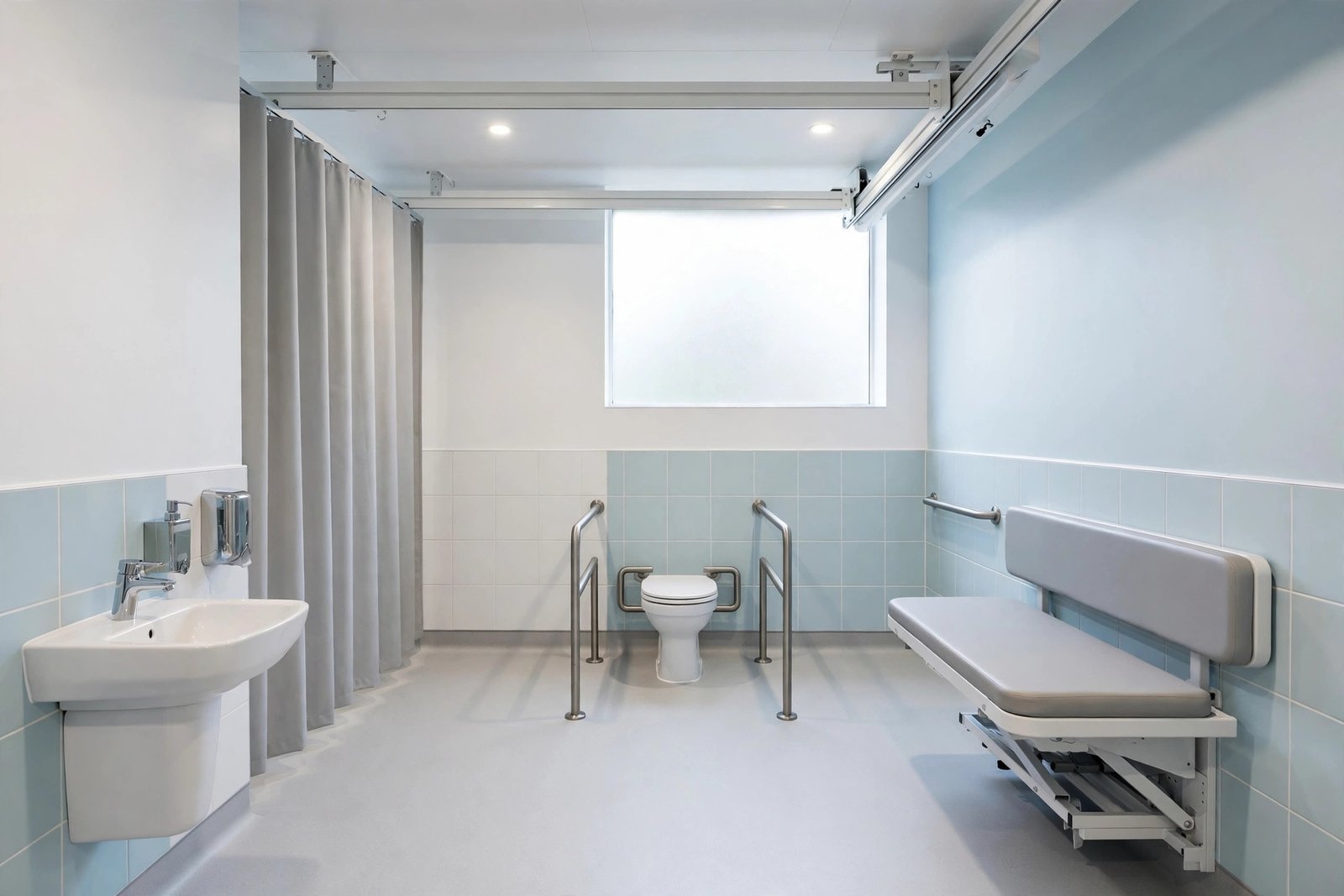
A Changing Places toilet is a larger accessible toilet with specialist equipment, built for people who cannot use a standard accessible toilet. The room has a ceiling hoist, a height-adjustable adult-sized changing bench, and a toilet set in the middle of the room so a carer can stand on either side. There is enough floor space for the person, their wheelchair, and up to two assistants.
The idea is simple: a toilet should be safe and dignified to use, wherever you are. Changing Places toilets give people with complex needs the same freedom to spend a day out that most of us take for granted.
Who Needs One?
More than 250,000 people in the UK need a Changing Places toilet. They include people with profound and multiple learning disabilities, spinal injuries, muscular dystrophy, multiple sclerosis, cerebral palsy and motor neurone disease. Older people with complex care needs use them too.
Needing one of these toilets is not always visible. Some people who use them walk unaided but cannot transfer safely without a hoist, or need a bench to change a pad. The facilities are open to anyone who needs the equipment, not only to wheelchair users.
What Is Inside a Changing Places Toilet?
Every registered Changing Places toilet follows the same standard, set out in the Changing Places Consortium practical guide. The room is at least 3 metres by 4 metres, giving 12 square metres of clear space, with a ceiling at least 2.4 metres high for the hoist track. Inside you will find:
- A ceiling track hoist that reaches the bench, the toilet and the basin, with a safe working load of at least 200 kilograms.
- A height-adjustable adult-sized changing bench, at least 1,800 millimetres long and 800 millimetres wide, moving from about 300 to 1,000 millimetres above the floor.
- A peninsular toilet, set in the middle of the room with space for an assistant on each side, plus grab rails.
- A privacy screen or curtain, so the person can be changed in private while a carer uses the toilet.
- A wide paper roll for the bench, a washbasin at a reachable height, a non-slip floor, and in some rooms a shower and a colostomy shelf.
Bring your own sling. Hoists do not come with a sling, and the sling has to fit the person using it. The Consortium guide is clear on one point: if you are not sure the hoist and sling work together, do not use the hoist.
How It Differs From a Standard Accessible Toilet
A standard accessible toilet is built for one independent wheelchair user. A Changing Places toilet is built for a person plus their carers and their equipment.
| Standard accessible toilet | Changing Places toilet | |
|---|---|---|
| Room size | At least 1.5 m by 2.2 m | At least 3 m by 4 m (12 sq m) |
| Hoist | No | Ceiling track hoist, 200 kg load |
| Changing bench | No | Adult-sized, height-adjustable |
| Toilet position | Against a wall | In the middle of the room |
| Room for carers | One person, at a squeeze | Space for up to two assistants |
A Changing Places toilet is provided in addition to standard accessible toilets, never instead of them. The two serve different people, and a venue that installs one still needs the other.
Where You Will Find Them
There are now more than 2,600 Changing Places toilets registered across the UK. In 2007 there were only 30, and the 2,000th was installed in November 2023. London alone has more than 100, in museums, galleries, stations, shopping centres and the big parks.
You will find them where a day out lasts a while: shopping centres, museums and galleries, theatres, sports stadiums, leisure centres, hospitals, motorway service areas, railway stations and airports. The Department for Transport has funded 54 of them across the motorway network in England, and six more have been added at major railway stations. If you are planning a trip around them, our guide to the best UK destinations for wheelchair users rounds up places where step-free access and proper facilities go together.
How to Find One Before You Travel
The official Changing Places map lists every registered facility in the UK. Type in a town or postcode and it shows the nearest toilets, with the venue, opening hours, and how to get in. The same site has a route planner that lets you plan stops along a journey and save the route.
Check three things on each listing before you rely on it. First, the opening hours: a facility inside a museum or shopping centre is only open while the building is open. Second, how to get in: some are open, some need a key from reception, and some need a RADAR key. Third, the feedback: users leave notes when a hoist is out of order or a room is being used as a store, and those notes are often more current than the venue website.
Getting In: RADAR Keys, Codes and Reception
Access works in different ways, and the map listing should tell you which one applies. Some Changing Places toilets stand open during opening hours. Others are kept locked and need a RADAR key, the National Key Scheme key run by Disability Rights UK. The same key opens thousands of locked accessible toilets across the UK. You can get one from the access officer at your local authority, or from Disability Rights UK for a small charge. The Changing Places FAQ explains the key scheme and who to contact.
A few venues run their own system. Manchester Airport, for example, opens its Changing Places toilets with a code from a courtesy phone outside, and a RADAR key does not work there. That is why the listing matters more than the key. If you are flying, our UK airport assistance guide explains how special assistance works from booking to boarding.
Keep the key with you on every trip, and carry your own sling as well. A hoist without the right sling is no use to anyone.
The 2021 Building Rule and Why Numbers Keep Growing
Since 1 January 2021, building rules in England have required a Changing Places toilet in certain large new buildings. Approved Document M covers assembly, recreation and entertainment buildings that hold 350 people or more, groups of smaller buildings on one site such as zoos and theme parks that hold 2,000 or more, shopping centres and retail parks of 30,000 square metres or more, shops of 2,500 square metres or more, sports and leisure buildings over 5,000 square metres, hospitals and primary care centres, and crematoria and cemetery buildings. It applies to new buildings and to buildings that change use.
Money has followed the rule. The Ministry of Housing, Communities and Local Government funded 483 Changing Places toilets across 220 local authorities in England, and the Department for Transport paid for 54 on the motorway network. Scotland has its own programme, with 10 million pounds of investment from April 2025. The campaign began in 2006, and 99 new facilities were added in 2025 alone.
Gaps remain. Rural areas and small towns still have far fewer than cities, and older buildings are under no duty to add one. The map shows where the gaps are as clearly as it shows the facilities.
What to Do When a Facility Is Locked, Broken or Missing
It happens. A hoist breaks, a room is locked with no one at reception, or the map sends you to a toilet that has been turned into a store room. Pick a backup facility near your first choice before you travel, and keep the venue phone number saved so you can ring ahead.
If a facility is out of order, leave feedback on its map listing so the next person knows. The Consortium relies on venues to report problems, and it says plainly that this does not always happen. Feedback through the map goes straight to the team that runs it, and you can also review facilities on the Cleen app, which flags problems to the venue.
If a place you visit often has no Changing Places toilet, ask the venue about its plans. The Consortium offers free advice to any venue that wants to build one, and many facilities exist because a local campaigner asked.
Frequently Asked Questions
Do I need a RADAR key to use a Changing Places toilet?
Not always. Some are open during the building opening hours, some need a key from reception, and some need a RADAR key. The map listing for each facility says how to get in, so check before you travel.
Can anyone use a Changing Places toilet?
They are for people who cannot use a standard accessible toilet because they need a hoist, a bench, or room for carers. They are not baby changing rooms. If you can use a standard accessible toilet, leave the Changing Places room free for someone who cannot.
Do I need to bring anything with me?
Bring your own sling for the hoist, and your RADAR key if you have one. Carry your own continence supplies too: the paper roll on the bench is a back-up, not a full supply.
Are Changing Places toilets free to use?
Yes. There is no charge to use a registered Changing Places toilet, though it is only open while the building it sits in is open.
What if the nearest Changing Places toilet is closed?
Use the map to find the next nearest, and ring ahead to check it is open and working. If you travel by train or through London often, our step-free London itinerary chains together stations, museums and galleries that have Changing Places facilities, so a closed room does not end the day.
The Bottom Line
Changing Places toilets turn a day out from a gamble into a plan. There are more than 2,600 across the UK, the map tells you where they are, and the 2021 building rule means more are coming. Check the map before you travel, carry your key and your sling, and leave feedback when something is wrong.